Berlin is a puzzle, even for the casual tourist. Where is the ‘city centre’, the usual historic core filled with tourists and heritage? The city is made up of many separate districts held together by the vast U-Bahn and S-Bahn rail systems. Why is it 19 times bigger than Paris, and the streets are oddly quiet? There are still fewer people living in Berlin than before World War Two. Why is the architecture so cold and mismatched?
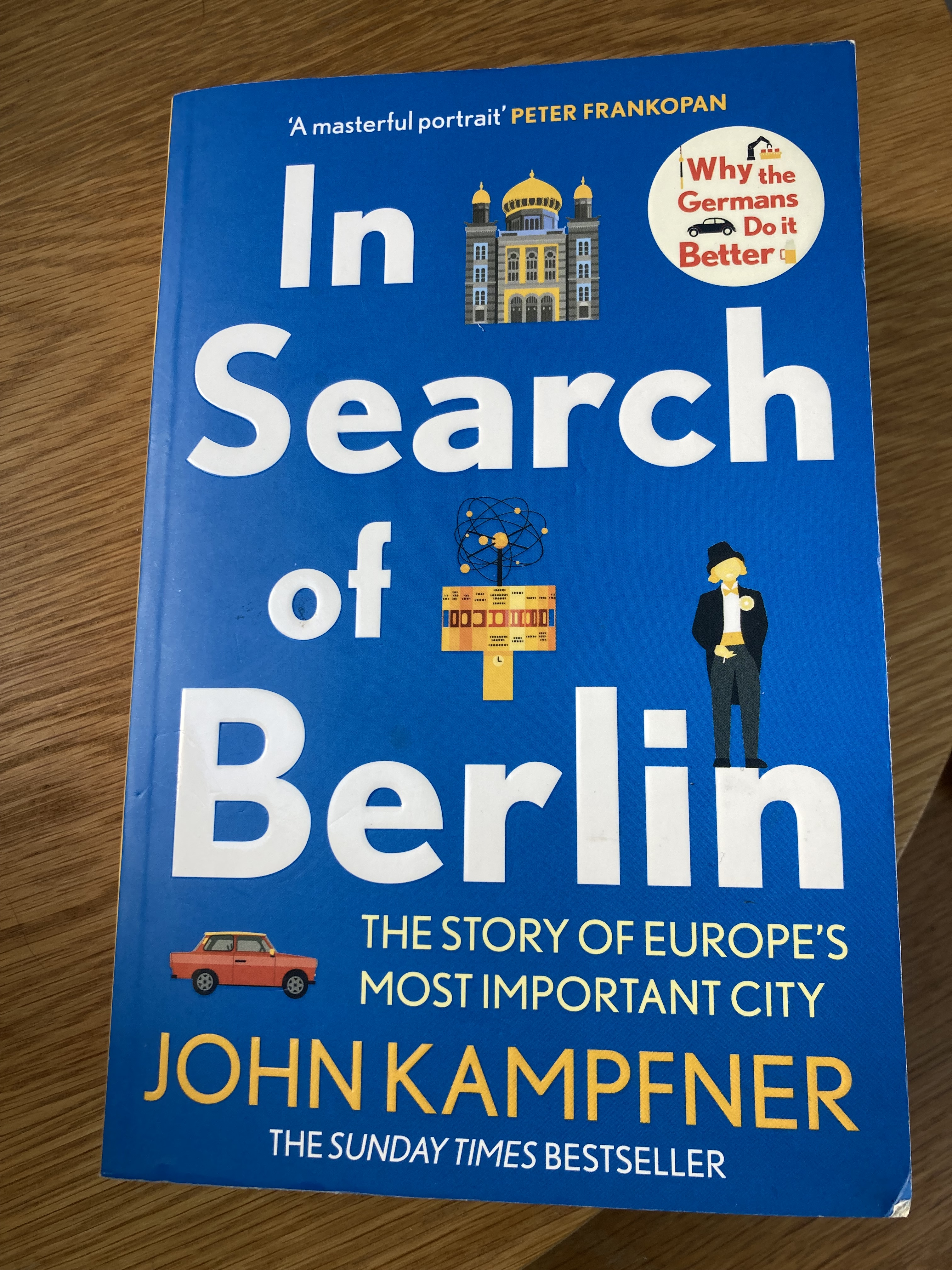
‘I can’t stop thinking about Berlin… it seeps into your skin,’ writes John Kampfner at the start of In Search of Berlin (Atlantic Books, 2023). I’m not sure he uses the word ‘puzzle’ but that’s surely why Berlin lodges itself in the mind. It feels like a place in need of deciphering, and the look and layout of the city are just the start. The people, the culture, and the atmosphere all point to an historical experience like no other.
This book is the follow up to the enjoyable Why the Germans do it Better – an analysis of contemporary Germany. Now the author is ‘in search of’ the capital – investigating the history, walking the streets, and interviewing commentators and experts about the city which he has visited and lived in since 1989. He tells the story of how a remote and late-developing backwater became ‘Europe’s most important city’. It’s a story made for chapters thanks to the seismic interruptions of history.
Berlin is elusive, partly because so much of it has been erased – demolished and rebuilt many times, and not just due to World War Two. The famous remark that Berlin is condemned ‘forever to become, never to be’ was made back in 1910. ‘Each site,’ writes Kampfner, ’almost each paving stone, has lived many lives, each era superimposing itself on the one before’.
And so we learn about how such-and-such royal residence or church or train station fell into disuse after a brief heyday, then later became a barracks or housed refugees, then burned down, and is now a Lidl. Hitler’s bunker remains submerged and mostly unmarked. As a history of a city, much of the book is not only about the powerful, and the people, but bricks and mortar: the lives of important buildings, where ordinary people were housed and worshipped, and the legacies of the vainglorious visions of imperial, Nazi, and communist urban planners.
Some of the earlier chapters may tire the uncommitted reader. You have to keep track of your Friedrichs, your Wilhelms, and your Friedrich Wilhelms (they of the house of Hohenzollern which for 500 years ruled the northern state of Prussia and then united Germany). But I was usually engrossed.
I didn’t know that Sweden brutally laid waste to much of Germany during the 1600s. I didn’t know about long-held German envy of France and Britain (and their capitals) which were thought to be more impressive and cultured. There’s an illuminating chapter on Berlin’s relations with Russia and Russians. A theme throughout the book is the impact of immigration, especially of Jews and Russians. Berlin has been a victimiser, but it has a long history as a sanctuary too. It remains a place apart within Germany – edgy, diverse, and distant.
Perhaps the best aspect of the book is how it flits between history and present-day memory politics. The chapter on the Nazi period is told through visits to memorials and museums. ‘With so many places in Berlin stained by the association,’ writes Kampfner, ‘how do Berliners cope in their daily lives? Can over memorialisation dull the senses?’ But that’s not the only era that still elicits strong emotions. Every street corner in Berlin, it appears, has a plaque to some tragic event or statue of a controversial character which has been wrangled over by locals for a couple of decades.
What, then, is behind the puzzle of Berlin? ‘Berlin is not really there,’ says one of Kampfner’s interviewees. ‘It’s an idea. It’s been a Prussian idea of a metropolis. A Nazi idea. An Allied idea. An East German communist idea, and more recently a young people’s idea.’
That’s why Berlin is so strange. None of these ideas succeeded but each has left its sediment.
And the city of reinvention is still ‘becoming’. In Search of Berlin explains a lot, but even better, leaves you with an urge to hit the streets to see if you can figure it all out for yourself.
 David Mitchell
Leave a comment