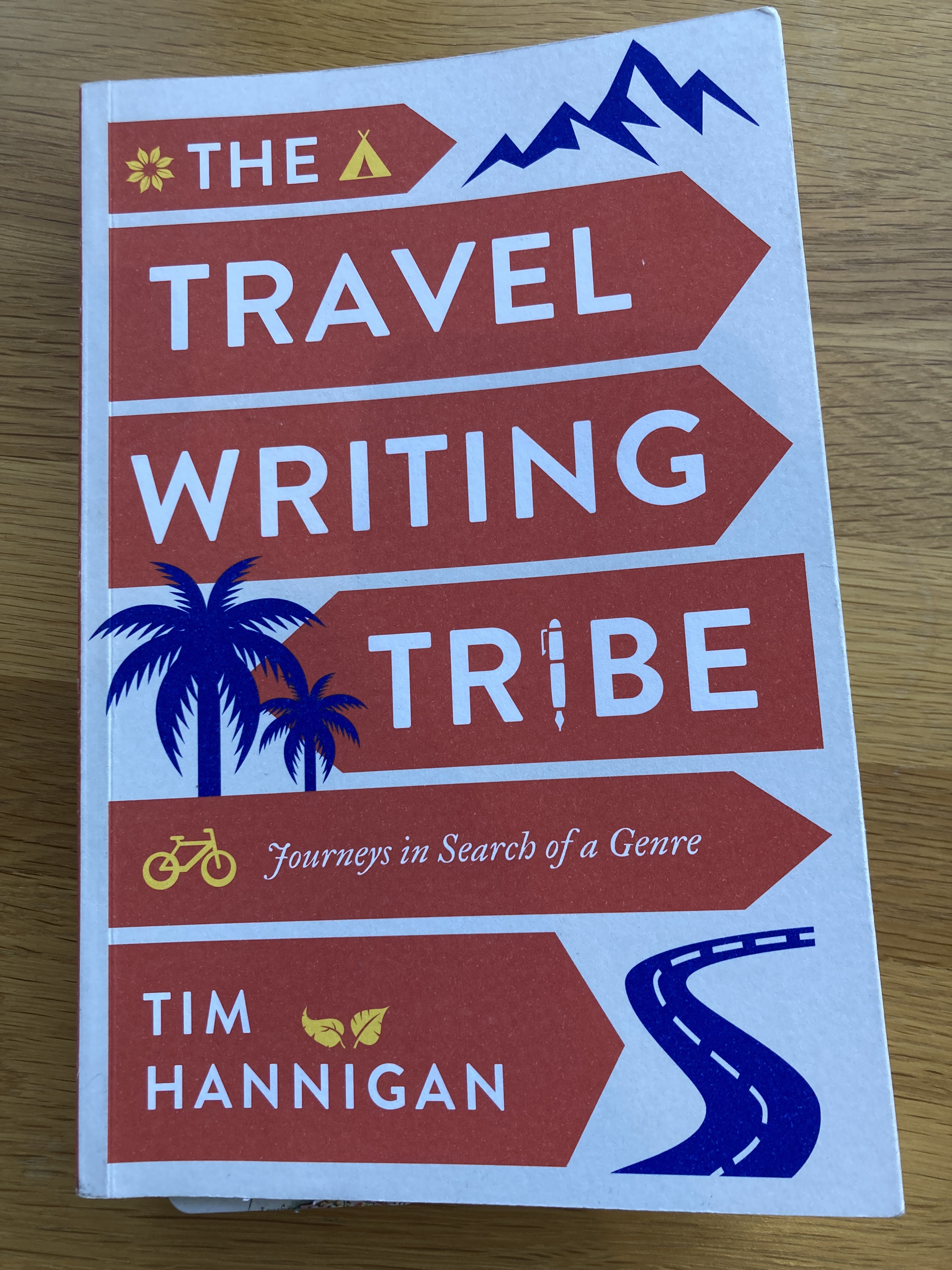
I read Tim Hannigan’s book about his native Cornwall, and then was eager to read this one, thinking it might explain something about my own, fairly recent, attraction to travel writing.
The Travel Writing Tribe is part travelogue, part personal reflection, part qualitative research. The bulk of it is a series of interviews with travel writers about their craft, but Hannigan takes the reader with him to the locations where he meets the writers, painting detailed portraits of them, their homes and locales using many of the travel writing techniques that he’s discussing with his interviewees.
Along the way he muses on academic perspectives and his own long history with travel writing. It’s very clever and page-turning, and the book overall, perhaps entirely unique.
But this isn’t a love letter. The author’s ‘quest’ is to find out if travel writing might be inherently, and perhaps irredeemably, broken.
To start with, can we trust it? I assumed that all travel writers tidy things up. I didn’t know that some make things up. But does it matter if it’s a good read? Can a little fiction get us closer to the truth? Hannigan puts these issues to his interlocutors, and finds varying levels of comfort with fabrication. He reminds one interviewee, who’s making a case for veracity, that ‘travel writers never go to the toilet’. Total faithfulness to the truth is too much to expect from a travel, or any, writer. (Hannigan, incidentally, mostly hides the fact that this book is a pop account of his PhD research).
Among the few books mentioned in The Travel Writing Tribe that I had actually read is A Time of Gifts and its sequels by Patrick Leigh Fermor, the story of his walk across Europe in 1933 that he wrote forty years after the journey. These also happen to be classic examples of the creative liberties taken by some travel writers. Fermor’s texts are hard work, spectacular, and often conjure scenes in mesmerising clarity – but no one’s memory is that good. Hannigan heads to an archive in Edinburgh and reverentially opens one of the original journals on which the books were based. In fascinating detail, he shows us exactly how much Fermor embellished and invented. Who knew an account of sitting in a library could be so enjoyable?
Travel writing can also easily be accused of elitism and sexism. At one point Hannigan is in the archives of Eton reading the diaries of William Thesiger, wondering if travel writing is just a pursuit of the posh. He quizzes Dervla Murphy and Sara Wheeler about whether there’s such a thing as women’s travel writing, and frets about his relative lack of female interviewees.
But Hannigan’s biggest worry about travel writing, not unconnected to class and gender, is that it’s colonial – privileged White people pronouncing about ‘exotic’ parts of the world for the entertainment of a White Western readership. Even modern travel writers may be working with the Orientalist tropes they picked up in their early reading. In fact, what right has anyone to show up anywhere and comment?
The travel writers are all conscious of the dangers. One, who writes about places in the UK, says that he couldn’t and wouldn’t do what he does further afield. But as we might expect, most of them feel that people must have these far-flung encounters if there’s to be any intercultural understanding. The traveller may even have a clearer view of a society than the locals and can bring attention to real people’s stories.
And there’s now more diversity in the genre. No longer does every journey start and finish in England, either literally or psychologically. Perhaps the most complex conversation is with Samanth Subramanian, an Indian writer living in Dublin. In some ways, he represents the colonised world getting its own back: he’s now writing a book about a British figure. But he’s also aware of his privilege as a Western educated English speaker with a British passport, who can move easily in the West, unlike so many of the people he has interviewed in India and Sri Lanka.
A remark by one of those people, a victim of the conflict in Sri Lanka, is underscored by Hannigan as encapsulating all these thorny issues of power-relations. When Subramanian asks Ismail for an interview, he agrees, but adds: ‘What good will this conversation do for me?’
Hannigan’s conclusion is that work by people like Subramanian shows that none of the ethical problems are intrinsic to travel writing. After all, Chinese and Arab wanderers were writing tales of their journeys centuries before Etonians took it up in the nineteenth century. Travel writing is defined as simply a true, first-person account of being on a journey or in a location, and isn’t existing in a place – not everywhere, or nowhere, but somewhere – at the heart of being human? Maybe this is why it draws in me and so many other readers. More accessible than poetry, more humane than scholarship, more real than fiction, perhaps travel writing is the most profound literary genre of all.
The Travel Writing Tribe is a terrific analysis and a good story. It will make you want to drop everything and set off – to the bookshop.
 David Mitchell
Leave a comment