A good bit of my growing up was done in Sligo, where I lived beside the huge Cathedral of the Immaculate Conception. I think I was inside it only once – for an ecumenical service. But from my bedroom window I saw two significant events outside the building.
One was the visit of Mother Teresa in 1996, a massive deal at the time. The other was the funeral of a young IRA man from the town, Joe McManus. I’ve always carried an image of a tricolour-draped coffin coming out of the cathedral doors with Gerry Adams among those carrying it. I recently began to doubt this memory, wondering if I’d added the flag or Adams, getting mixed up with countless television images of IRA funerals. But it seems not. The death and funeral of McManus in February 1992 are well documented, and the flag and Adams were there.
There’s obviously a lot about modern Ireland encapsulated in that single image: Irish religion, nation, and militancy fused together. But I was amazed to find a photograph of the cathedral itself in this new history of Ireland. The author, James Hawes,[1] mentions the building of the church as an part of the emergence of what we now think of as ‘traditional Catholicism’ after the famine. The cathedral was opened in 1874 by Cardinal Paul Cullen, the man largely responsible for the reorganisation and disciplining of the Irish Catholic Church. The imposing cathedral dwarfed – and dwarfs – the smaller St John’s Church of Ireland cathedral beside it.
This was the period when Catholicism and Irishness merged. Yet this is page 173 of 265 – how surprisingly late this was.
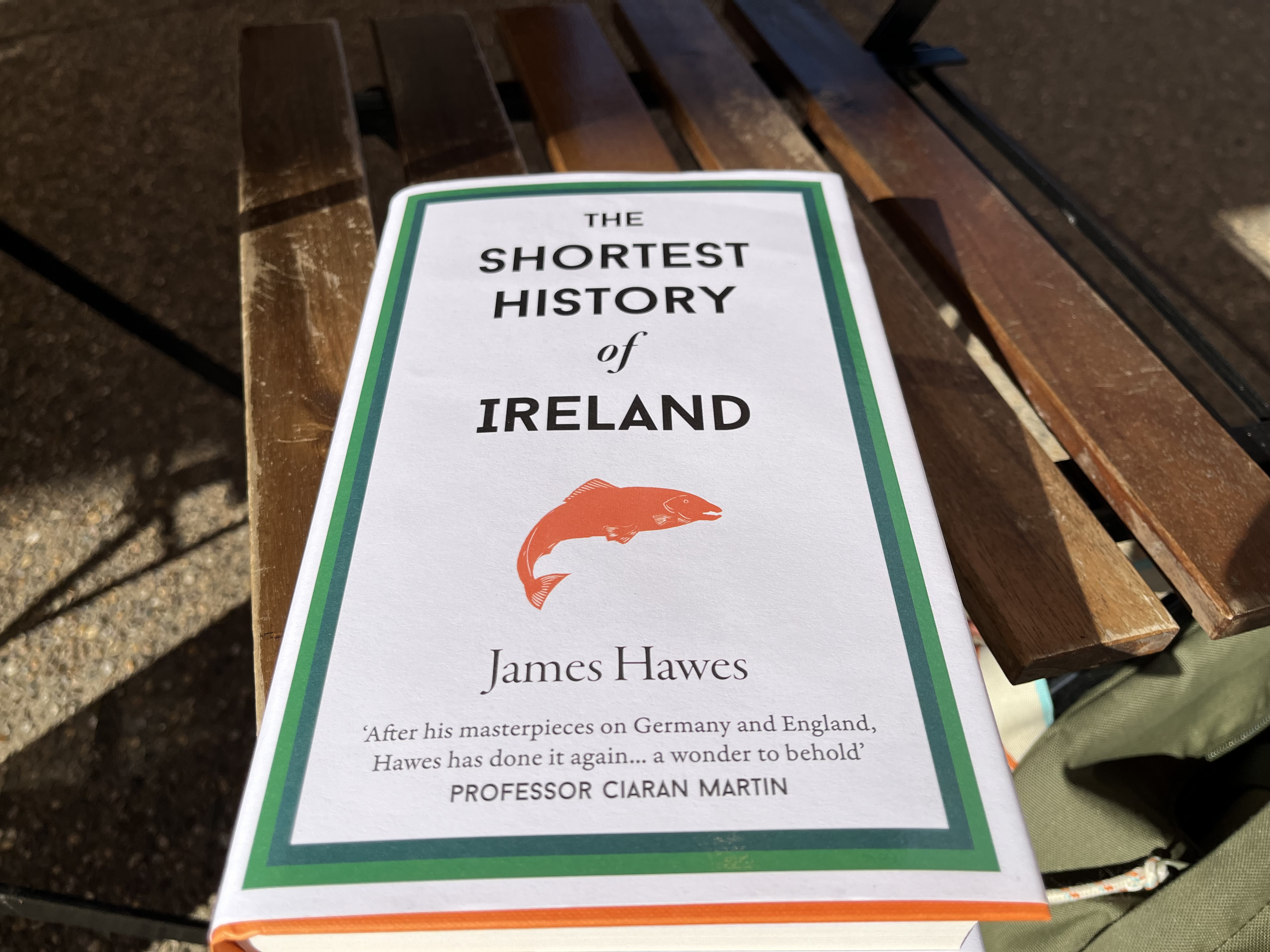
The Shortest History of Ireland is Hawes’s third such book, after Germany and England. I haven’t read the latter, but The Shortest History of Germany hammers home an arresting argument: there is not one ‘Germany’ but two, Germany (the South and West – Catholic and a natural part of Western Europe) and Prussia (Protestant and a place apart, responsible for dragging all of Germany down with its imperialism). Would his book on Ireland have a similar, spectacular central idea? It does.
Ireland is naturally, should be, and will be, a united country. But it was once, and should be again, organised federally.
As with his treatment of Germany, Hawes roots his thesis in distant history and takes it from there. He flits between centuries, often using deliberate anachronisms to explain the long patterns of history. For example:
‘Every Gaelic poet and historian thought it was obvious that the four provinces (five “fifths”, if you counted Meath as a separate unit) were grouped North/South, into Leth Cuinn and Leth Mogha, along an ancient soft border marked by the Escer Riada. On the eve of the great invasion, Ireland had developed its own form of medieval federalism – the High Kingship’.
The Greater Dublin of today – which dominates the political and economic life of the country – maps almost exactly on to the old Pale, long-time bastion of English control. The centralisation of Ireland is a colonial legacy, which, says Hawes, the political class would do well to end –along with partition, of course, which I will come to.
The other big theme is how Ireland has always been remarkably good at absorbing incomers and making them want to be Irish. This is why, the author argues, we must ditch the notion that the conflict between Ireland and Britain has been about ethnicity or religion. Sectarianism, we’re told many times, was imported by Anglican fundamentalists to divide and rule. It’s not an inevitable enmity between tribes in Ireland. Conflict wasn’t even always between ‘English’ and ‘Irish’. The invading Normans, after all, were French ex-Norse (supported by the Pope), while ‘Irish’ at times just meant people of any ethnicity the Crown didn’t like.
The struggle has been about power and where it should reside: with the Crown in London, or on the island. Consider all the Irish nationalist leaders who were Protestant (Tone, Emmet, Parnell, Butt, Hyde…), as well as Catholics who were content enough under British rule. Throughout the book, Hawes has an eye for the seismic turning point, and for moments when a non-sectarian, independent and united island might have been born but wasn’t – whether through lack of strength, internal divisions, or bad luck.
One thing the book doesn’t do is make much sense of northern unionism. Unionism is rolled in with the Irish story’s leading antagonists, ‘Tory imperialists’. We’re given no impression that unionists might have had their own reasons for wishing to keep Ireland in the UK or a genuine cultural affinity with people across the water. They don’t feature that much at all, other than occasional glimpses of ‘Orange mobs’ up in Belfast.
The book also doesn’t acknowledge that the unionism of today remains shaped by the post-partition unattractiveness of the southern state – something the book does have much to say about – or the trauma of ‘the Troubles’. That conflict too, I’d say, is underplayed, even in a book that must cover millennia.
This brings us to the striking and cheerfully unification-ist conclusion.
The UK is on the way out and partition will go with it: ‘History is only going one way: soon, the identity born in Ulster [i.e. British] by royal command of King James I will become meaningless’. Once the UK disintegrates thanks to English nationalism, loyalists will ‘quickly do as ex-colonists have done again and again across the centuries and start thinking that they are, after all, not just in Ireland, but some kind of Irish.’
I’m not so sure that anything is inevitable, or about the idea of finding in history the ‘natural’ condition of countries. But Hawes is surely only stating fact in saying that if the UK ends, Ulster unionists, unless they are going to raise an army and fight their own government as they threatened to do in the 1910s, will have to adapt. Indeed, many already feel ‘some kind of Irish’.
In terms of format, the book follows Hawes’s previous histories: lots of photos, reproductions of historical documents, and diagrams which visualise complex processes, statistics, and events. The author has a knack for dropping in evidence at the right moment to bring to life some fascinating point. Despite the book’s heavy-handed arguments, the pages are full of intricate facts and connections that will surprise anyone who thinks they know Irish history. It’s also strong on revealing how pivotal was Ireland in the historical courses of both England and the UK. Quite a read.
[1] There’s enjoyable interview with Hawes on RTÉ radio here.
 David Mitchell
Leave a comment